
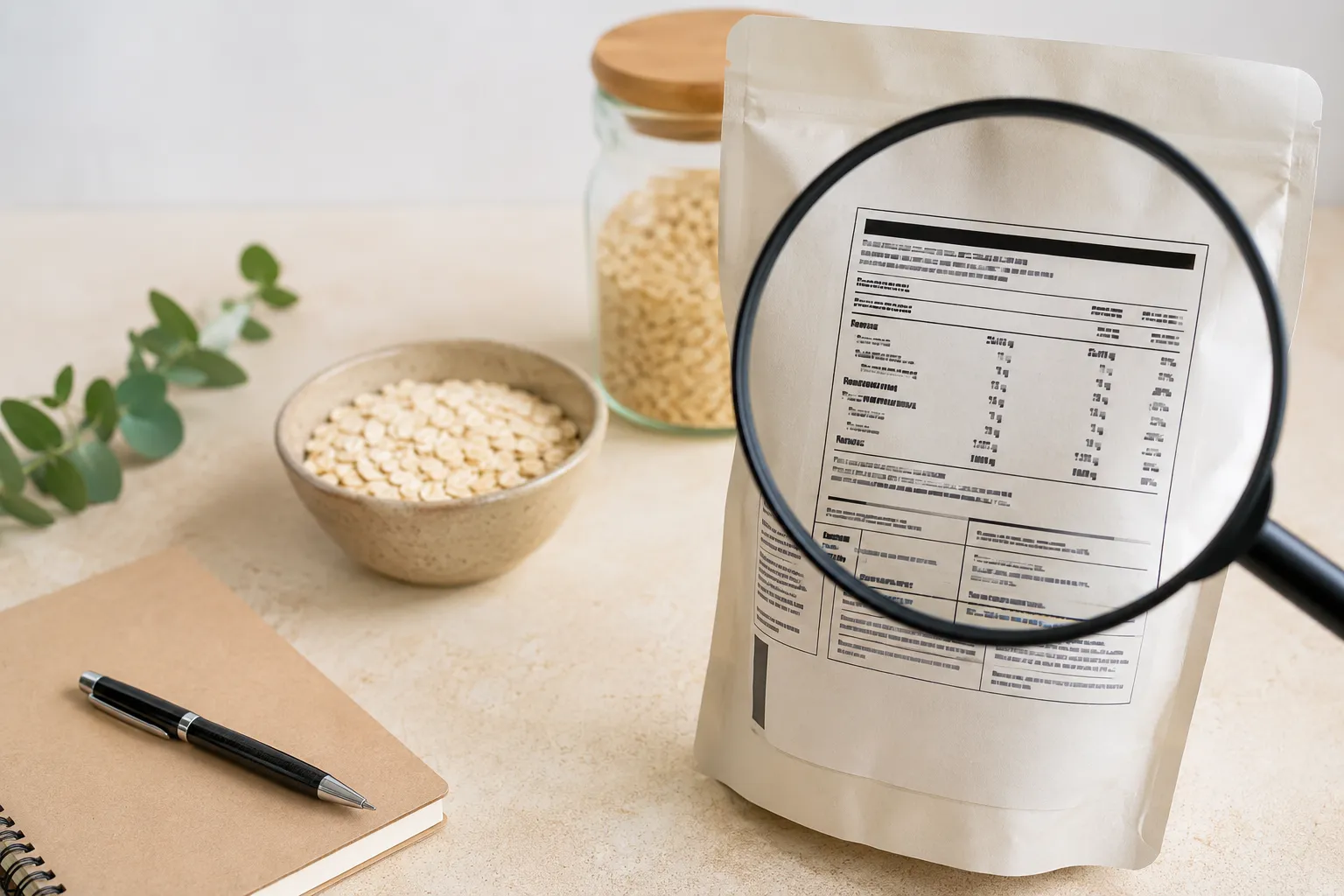
Almost every packaged food sold in New Zealand carries a nutrition information panel (NIP). The rules for what it must contain are set by Food Standards Australia New Zealand, so once you know how to read one panel you can read them all — and, more usefully, compare two products fairly.
What the panel must show
A NIP has to declare the average amount of each of these:
- Energy (in kilojoules)
- Protein
- Fat — total
- Saturated fat
- Carbohydrate
- Sugars
- Sodium (salt)
Each is shown in two columns: per serving and per 100 g (or per 100 mL for drinks). Both are required. That second column is the one that does the real work.
Compare on the per-100 g column, not per serving
Here is the trap. The serving size is chosen by the manufacturer, so “per serving” numbers on two products are often not measuring the same amount of food. A cereal that looks lower in sugar per serving might just have a smaller declared serving.
The per-100 g column is standardised, so it lets you compare two products directly. To pick the lower-sugar or lower-sodium option between two packs, read across the per-100 g column and ignore the serving column for the comparison.
A rough guide many people find useful: for sugar, under about 5 g per 100 g is low and over ~22.5 g is high; for sodium, under ~120 mg per 100 g is low and over ~600 mg is high. Treat these as orientation, not rules.
The ingredients list tells you the proportions
Ingredients are listed in descending order by weight. The first ingredient is the largest component of the product, the last is the smallest. If sugar (under any of its many names) appears near the top, there is a lot of it, whatever the front of the pack says.
What the panel does not tell you
- % Daily Intake figures, where shown, are optional and based on an average 8,700 kJ adult diet — a reference point, not your personal requirement.
- A panel only has to break out extra nutrients (like fibre) when a claim is made about them. A “good source of fibre” claim, for example, forces the fibre content onto the panel — and all such claims have to be substantiated under the Food Standards Code. What a “high protein” claim has to meet is a worked example of one of those rules.
- The panel says nothing about how a food fits your overall diet. It is a comparison tool, not a verdict on whether a food is “good” or “bad”.
The short version
Read the per-100 g column to compare products, read the ingredients list to see what a food is mostly made of, and treat the front-of-pack marketing as marketing. The panel is the honest part of the label — it just takes a moment to use it the way it was designed. For whole foods rather than packets, the equivalent reference is the per-100-gram figures for common New Zealand protein foods, which come from the national food composition database.
Sources
- Nutrition information panels — Food Standards Australia New Zealand
- How to read food labels (interactive labelling poster) — Food Standards Australia New Zealand
- Nutrition content claims and health claims — Food Standards Australia New Zealand
General information only. Not personalised nutrition or medical advice.
Spotted something wrong? Corrections are welcome — email editorial@proteinnotes.com. How this page was researched is set out in our editorial standards.