If you have read that most herbal supplements on the shelf are not what they claim to be, you have almost certainly read a descendant of one 2013 paper. That paper no longer stands.
This review covers two things: what DNA testing can and cannot establish about a herbal product, and what happened to the study that made the technique famous.
What DNA testing can do
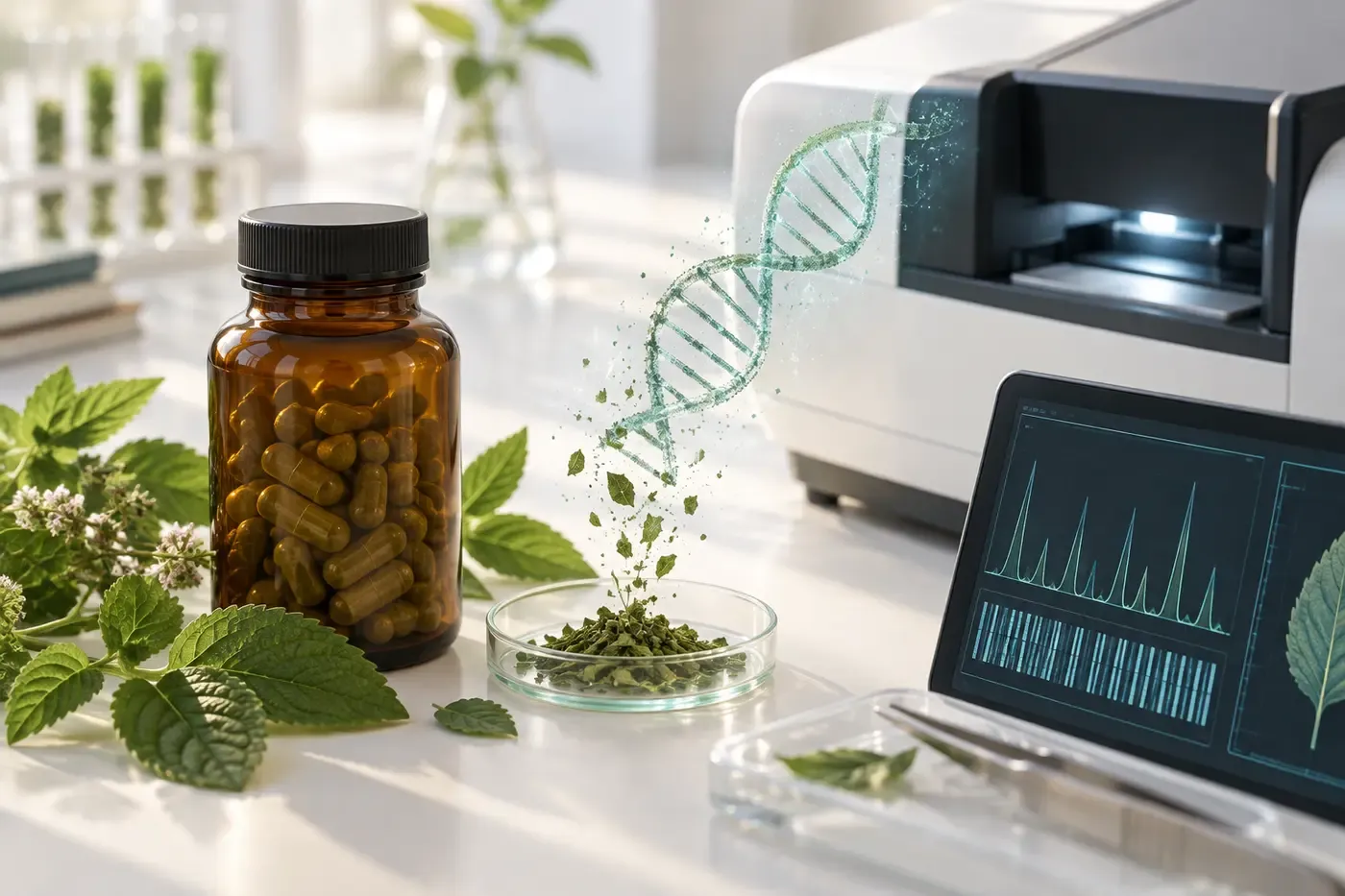
A laboratory amplifies a standardised region of DNA from a sample and compares it against a curated reference library. Where intact genetic material is present, the method can confirm an expected species or flag undeclared biological material.
Metabarcoding and next-generation sequencing extend this to mixtures. Results still depend on primer choice, the quality of the reference library, contamination control and how the data are interpreted — none of which is visible in a headline result.
Why finished products are difficult
Grinding, heating, solvent extraction, purification, fermentation and long storage all fragment or remove DNA. A genuine, high-quality extract may therefore yield very little amplifiable plant DNA, and a negative result can reflect the manufacturing process rather than a substitution.
The reverse error is also possible. Trace DNA from a filler, or from the handling environment, can be detected even where it has no pharmacological meaning at all.
Both failure modes point the same way: a DNA result on a processed botanical product is a weak instrument used alone.
The correction that changed the evidence base
The 2013 study by Newmaster and colleagues, published in BMC Medicine, reported that a large share of tested North American herbal products contained unlisted ingredients. Its headline figures — commonly quoted as 59% problematic, with about a third of products containing no detectable target species — drove years of media coverage and a 2015 New York Attorney General investigation.
BMC Medicine retracted that paper in July 2024. The retraction followed a University of Guelph investigation that found evidence of data fabrication in relation to the article; the journal stated it no longer had confidence in the data. Four of the authors have publicly disagreed with the retraction. Canada’s research-integrity body subsequently judged Guelph’s initial investigation inadequate and directed the university to open a second one.
Two things follow, and they are easy to confuse. The first is that the 59% figure should not be cited as evidence — not because a better number replaced it, but because its source is no longer reliable. The second is that the retraction is not a clean bill of health for the herbal supplement industry. Other work has found authenticity problems; the rates vary by product, region, method and definition. The retraction removes one widely used piece of evidence. It does not settle the question in either direction.
What stronger quality control looks like
No single test authenticates a botanical product, which is the practical conclusion underneath all of this.
Macroscopy and microscopy identify intact plant structure. Chromatography and spectroscopy measure characteristic marker compounds. DNA methods support species identity where usable DNA survives. Separate assays test for microbial contamination, heavy metals, pesticides and undeclared pharmaceuticals.
The strongest position comes from a fit-for-purpose combination of these, a documented supply chain, validated reference materials and stated acceptance criteria. A consumer cannot audit that directly, which is why the certification question is a separate one — covered in what a “third-party tested” seal actually proves.
For New Zealand buyers, the labelling rules that govern what a product may claim are set out in what supplement labels are allowed to claim in New Zealand.
Sources
- Retraction Note: DNA barcoding detects contamination and substitution in North American herbal products — BMC Medicine
- Journal retracts DNA barcoding paper that sparked 2015 NYAG herb investigation — NutraIngredients
- BMC Medicine retracts flawed 2013 publication by Newmaster et al on DNA barcoding — American Botanical Council
General information only. Not personalised nutrition or medical advice.
Spotted something wrong? Corrections are welcome — email editorial@proteinnotes.com. How this page was researched is set out in our editorial standards.